
Scuba Diving in Palau: Highlights + Liveaboards vs Resorts
Thinking about scuba diving in Palau? Discover everything you need to know about exploring this island nation, including what you can expect to see underwater and whether to opt for a liveaboard vs resort-based dive vacation in Palau.
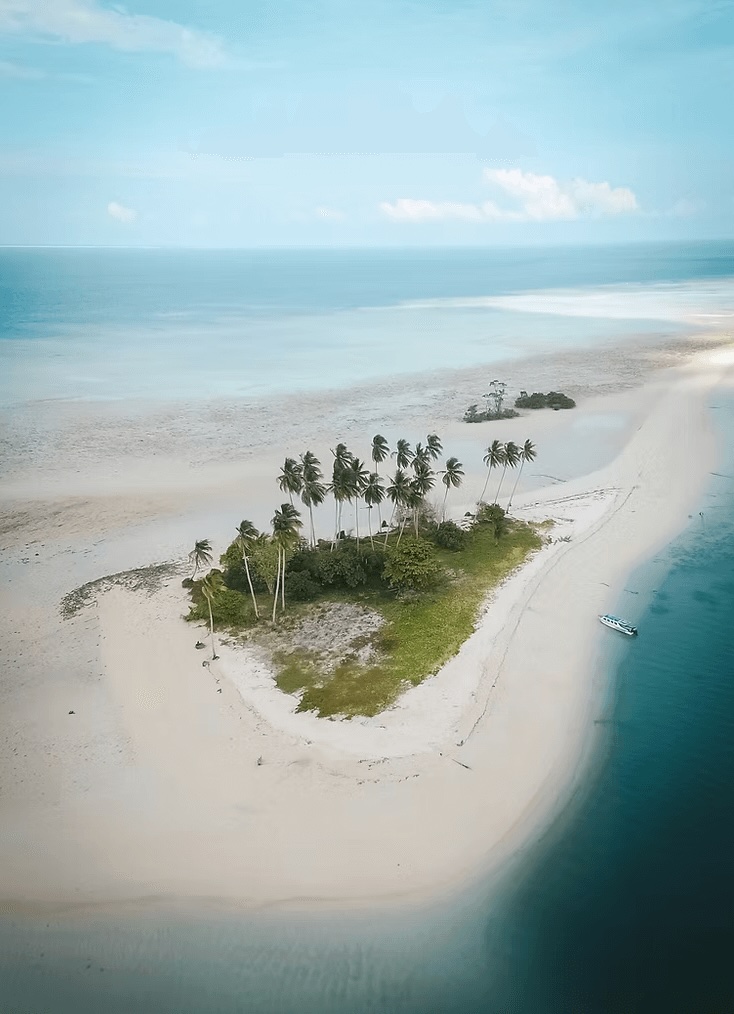
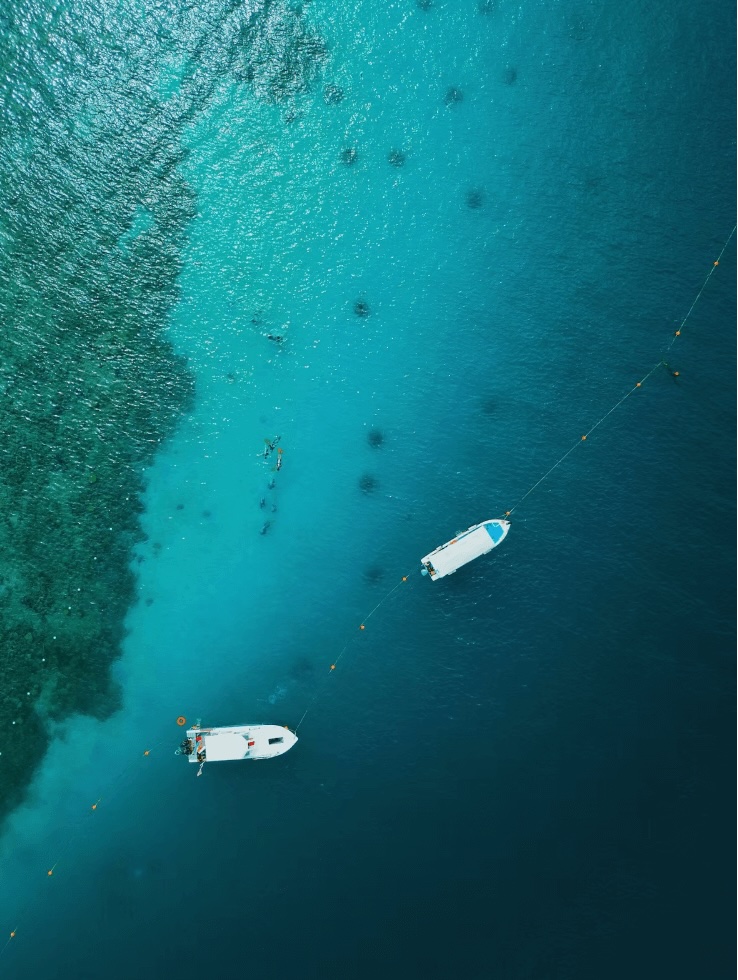
Comprising 340 islands in the northwest Pacific Ocean (between the Philippines and Guam), Palau is arguably one of the world’s best scuba diving destinations.
It might be far-flung and seemingly in the middle of nowhere, but that’s not stopping divers from flocking there…including us! Palau is a destination that left a big (and we mean BIG) impression on us and we can’t wait to go back.
In this article, we’ll explain everything you need to know about scuba diving in Palau, from logistics and weather considerations to eco-friendly resorts and hotels. By sharing our experiences, we hope to inspire you to visit and discover this absolute paradise first-hand.
If you’re looking for a non-diving activity to do in Palau the day before you fly, we highly recommend kayaking around the Rock Islands with Paddling Palau. Alternatively, you can rent a car for a self-driving road trip around Babeldaob Island.

This article contains affiliate links, which means when you make a purchase through that link, we earn a small commission. Affiliate links come at no cost to you and ensure our content remains free!
What makes Palau so special as a dive destination?
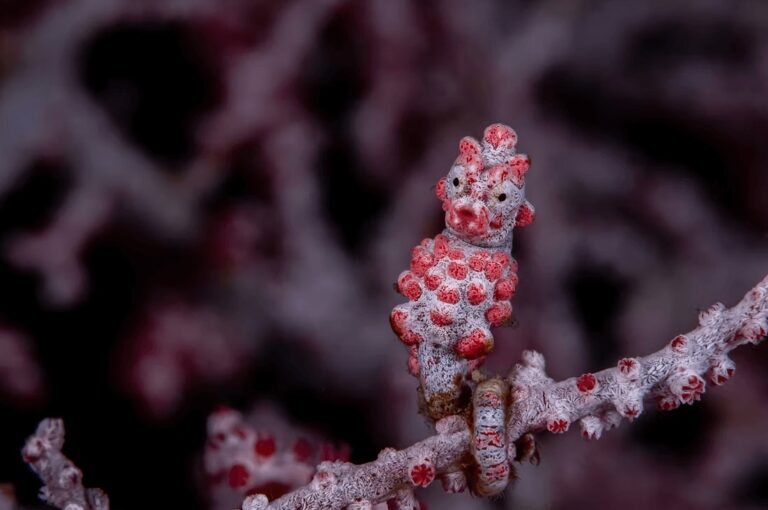
Palau’s waters boast an astounding diversity of marine life, spanning from the minuscule and intricate to the majestic and awe-inspiring. Of its islands, 70 belong to a fully protected marine reserve, so its underwater ecosystems are allowed to thrive.
At the same time, its people have made an unwavering commitment to environmental preservation.
In fact, the importance of protecting the nation’s natural resources is so paramount that visitors to Palau are required to sign a “passport pledge” upon arrival. This says that you vow to behave in an ecologically and culturally responsible manner during your stay.
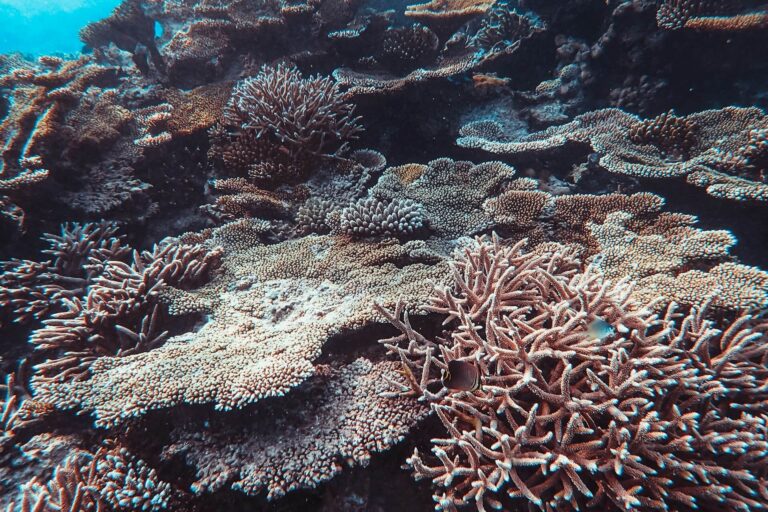
In total, the archipelago is home to around 500 species of corals (it’s one of the most coral-diverse places in Micronesia), not to mention 1,400 species of reef fishes, and 7 out of the 9 known species of giant clams worldwide.
A highlight of scuba diving in Palau is its Shark Sanctuary – a 600,000 square kilometre zone (comparable in size to Thailand). Here, commercial shark fishing is strictly prohibited and this is reflected in the sheer number of sharks we saw during our dives.
It’s also home to the most isolated population of dugongs (a relative of the sea cow) in Micronesia. Unfortunately, we didn’t see any dugongs…but maybe on the next visit!
Complementing this astounding marine biodiversity are Palau’s untouched forests and its famous Jellyfish Lake. It’s home to a distinct species of jellyfish that has evolved here in isolation.
We also saw the ancestors of these jellyfish while snorkelling in Risong Bay and the equally captivating blue moon jellyfish, which was an absolute treat!
While Palau may not be as well-known for its shipwrecks as neighbouring Chuuk Lagoon, the archipelago does boast over 60 World War II-era wrecks. Collectively, they are referred to as the “Lost Fleet of the Rock Islands.”
During our trip, we dove three different wrecks, including the “Helmet”, which was particularly special as it hasn’t been salvaged. On board you can still see gas masks, beer bottles and a ceramic sake jar abandoned by its Japanese crew.

Liveaboard vs land-based diving in Palau
When planning a dive vacation in Palau, you have the option for liveaboard diving or resort-based diving. Each option offers its own advantages – it really comes down to personal preferences and what your priorities are.
It’s worth noting that most diving takes place within an hour’s boat ride of Koror, with the exception being the dive sites around Peleliu. Of course, staying on a liveaboard means your boat rides to dive sites will be much shorter…and you can get an earlier start in the morning (and potentially avoid the crowds).
Essentially, the liveaboard experience in Palau allows you to maximise your time underwater. You can expect up to four dives per day, including sunset and night dives that reveal the ocean’s nocturnal wonders. So if your priority is dive, dive, dive, then a liveaboard might be the way to go.
With shore-based diving, most operators cap the daily dives at three, finishing by mid-afternoon. This means you have time in the late afternoon/evening to laze by the resort pool, explore Koror and check out the local dining scene.
This is what we did on our dive trip to Palau and we were really happy with the choice. It allowed us to visit the Belau National Museum (which is great for understanding Palauan culture and history) and we dined at a different restaurant each night.
ROCK ISLANDS PERMITS
Whether you’re doing a liveaboard, a land-based dive trip or snorkelling/kayaking in the Rock Islands, you’ll need to get a permit. These can easily be purchased from your dive/tour company on the first day of your trip and cost 50 USD for five days if you’re NOT doing Jelly Fish Lake. Rock Islands permits that INCLUDE Jelly Fish Lake are 100 USD for five days.
In terms of price, a Palau liveaboard may appear pricier upfront. But the overall cost is probably comparable once you factor in the limited budget accommodations that are available in Koror. Dining out is also relatively expensive – expect to pay at least 15-20 USD for a meal.
By living and diving directly from the boat, a Palau liveaboard trip is an all-inclusive experience. Meals, accommodations and multiple dives are covered in the one package.
That being said, staying at a Koror hotel or a Palau dive resort gives you greater options when it comes to dining. You’ll also have access to a wider range of facilities, such as gyms, tennis courts and swimming pools.
A land-based dive trip to Palau may be a better choice if you’re travelling with non-diving family members and/or want to experience some of Palau’s other attractions. Also, it means you can “escape” your dive group – just in case you end up with one (or a few) people who push your buttons.
Looking for liveaboard inspiration? Discover 8 eco-friendly liveaboards around the globe.

Which are the best dive operators in Palau?
For English speakers, we were recommended Sam’s Tours, Fish ‘n Fins, Palau Dive Adventures and Palau Escape.
Due to availability, we went with Sam’s Tours and they were fantastic! On time pickups every morning, a really smooth operation on the waterfront and all the drivers, guides, captains were super friendly and knowledgeable.
Several companies cater primarily to Chinese and Japanese divers, with guides that speak those languages. Underwater, it doesn’t matter so much. But for briefings, we recommend sticking with a Palau dive operator in a language you understand.
Our biggest tip is to BOOK EARLY! Don’t expect availability when you arrive. We struggled even in May when booking two weeks out from our travel date. A couple of people we dived with were having to move between companies just to get a spot on a dive boat on the days they wanted to go out.

Eco-friendly resorts and hotels in Palau
Palau Central Hotel
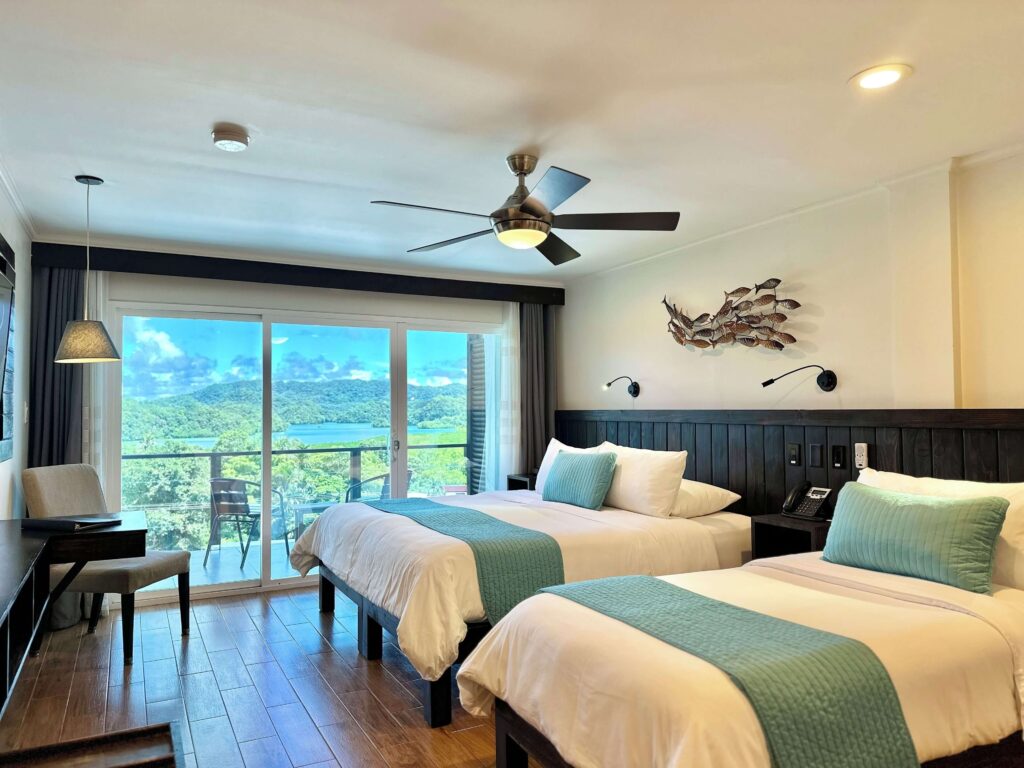
This is where we stayed in Koror and we loved it! It’s really central (hence the name!) and you can easily walk to restaurants and museums.
While it originally opened in the 1980s, Palau Central has had a recent upgrade and everything feels pretty new. In total, there are around 50 rooms, giving the hotel a boutique feel.
All of the rooms are air-conditioned and most have balconies – ours had a view overlooking the Rock Islands. They are really spacious, so there’s heaps of room for dive gear, particularly when you’re trying to get things dry at the end of your trip.
Outside, you’ll find a swimming pool surrounded by a grassy area, complete with a day bed, hammock and several games. Also part of the hotel complex is a spa and the Canoe House – a lively restaurant and watering hole that does good pizzas, burgers and beer!
Breakfast is included in the rates at Palau Central Hotel and the staff are all so incredibly friendly. We didn’t want to leave!
Palau Pacific Resort
Nestled among 64 acres of tropical gardens is this award-winning Palau resort – it’s one of the fancier places to stay in Koror. It features traditional, cottage-style guest rooms with private balconies or patios, as well as a handful of overwater bungalows.
Beyond the accommodations, there’s a full-service spa, a state-of-the-art fitness centre and a jacuzzi, plus tennis courts and a PADI 5-Star dive centre.
A highlight is definitely the private beach, with snorkelling just offshore. If you want a real “resort experience”, this is the place to stay! The only downside? It’s not within walking distance of local restaurants.
What we love about the Palau Pacific Resort is that is supports conservation efforts aimed at protecting the region’s unique biodiversity. It proudly promotes eco-tourism activities that you can book directly with their team.
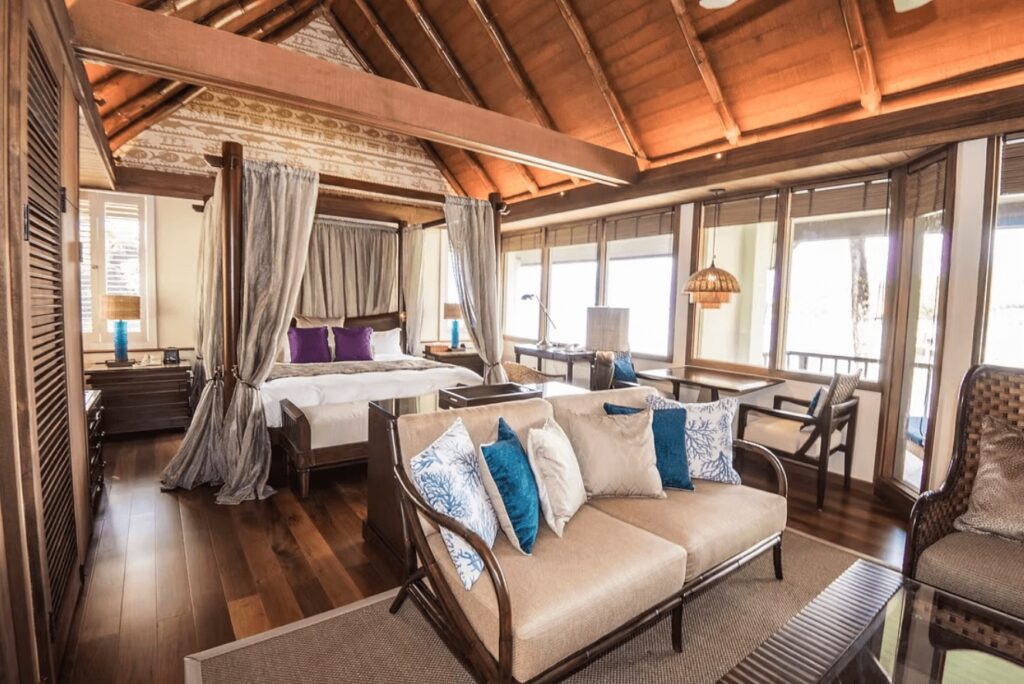
Cove Resort Palau
Centred around one of the largest lagoon swimming pools in Palau, this luxury resort boasts an enviable waterfront setting on Malakal Island. As with the Palau Pacific Resort above, it’s located away from the downtown area, which is a plus in terms of serenity and a minus when it comes to restaurant accessibility.
While the rooms at the Cove Resort Palau are getting a little rough around the edges, we’re hoping an upgrade is in the works. From what we’ve heard, the poolside rooms are the ones to go for!
A highlight of staying here is definitely dining at the Hungry Marlin Restaurant. Here, you can savour the freshest local seafood as you gaze out over the stunning marina.
Aside from diving and snorkelling excursions, this eco-friendly Palau resort can also arrange swimming with dolphins trips.
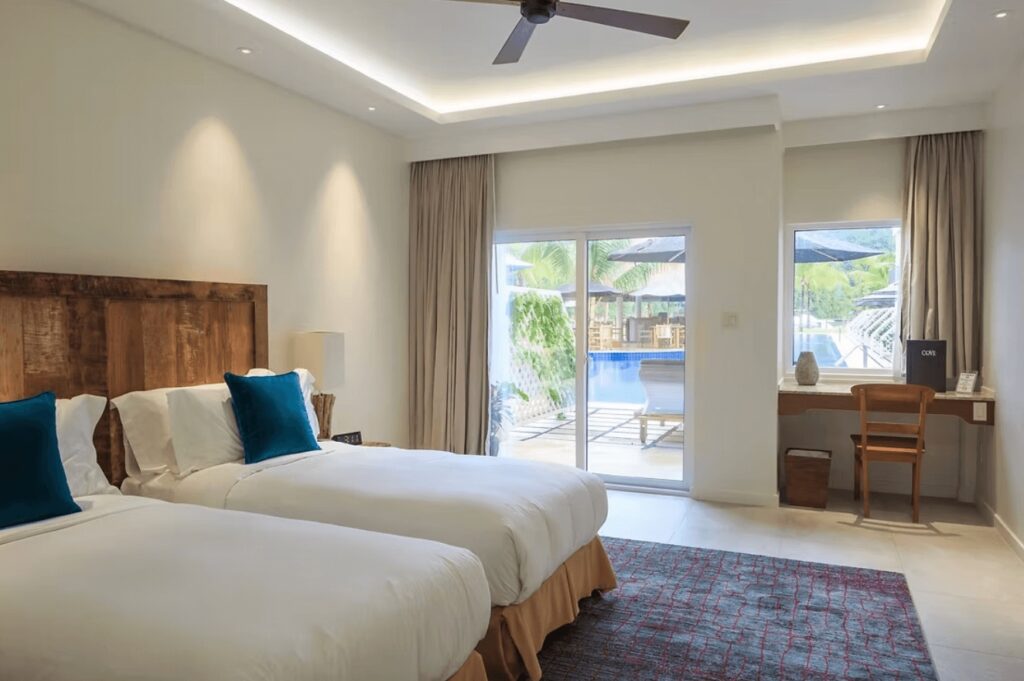
Palau Royal Resort
As one of only two hotels in the area boasting a private beach, this eco-friendly Palau resort offers a quintessential island vacation experience. We think it’s a particularly good choice if you’re travelling with kids, as the beach (and snorkelling) area is enclosed by a rocky wall.
After a day of diving adventures, you can lounge poolside or indulge at the Mandara Spa. Dining is available at the open-air Waves Restaurant – it’s a great option if you don’t want to venture into town, which is a taxi or shuttle ride away.
Demonstrating its commitment to sustainability, Palau Royal Resort proudly partners with organisations like the Palau Conservation Society. It’s striving to ensure that this tropical paradise remains pristine for generations to come.
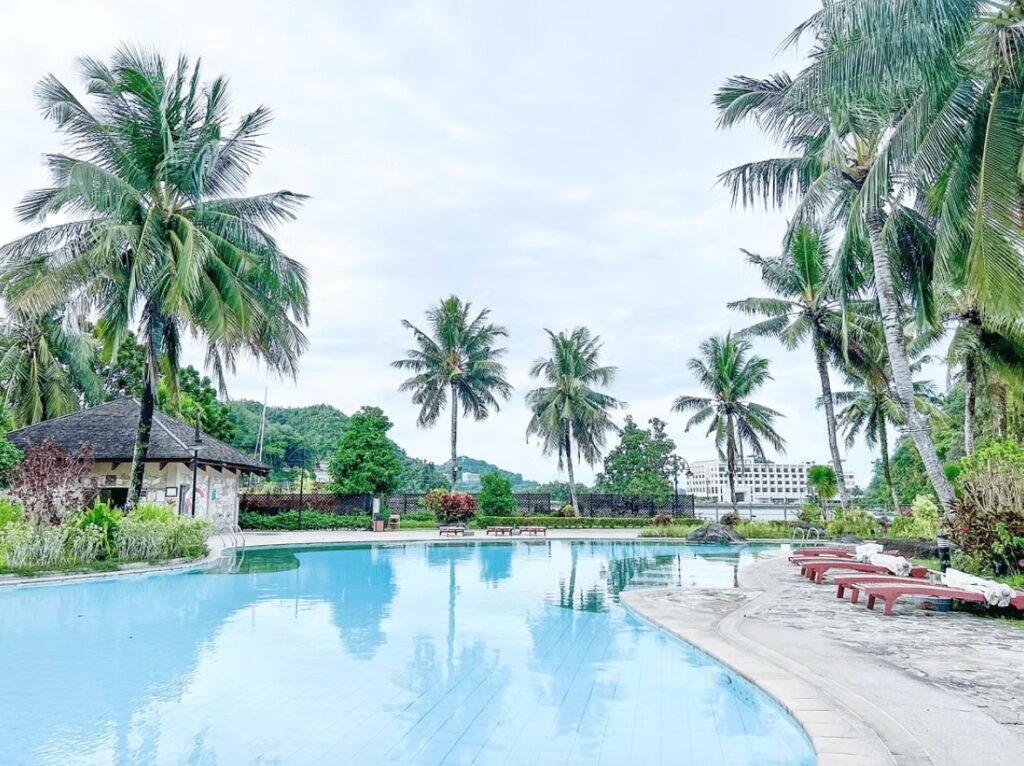
Palau Carolines Resort
Inspired by Palau’s centuries-old architecture, this atmospheric resort features eight private bungalows, all of which have been recently renovated. It’s located in the village of Ngerkebesang, a short drive or taxi ride from Koror.
While Palau Carolines Resort doesn’t have an on-site dive centre, the friendly owners can easily connect you with local operators. The main downsides are its distance from local restaurants (it’s best to have your own car) and the lack of a swimming pool.
Stays at this highly-rated Palau eco-resort are all about connecting with nature. Personally, we think it’s a great place to stay at the end of your trip, once you’ve finished diving. The views are sublime and it has a really intimate, “boutique” feel about it.
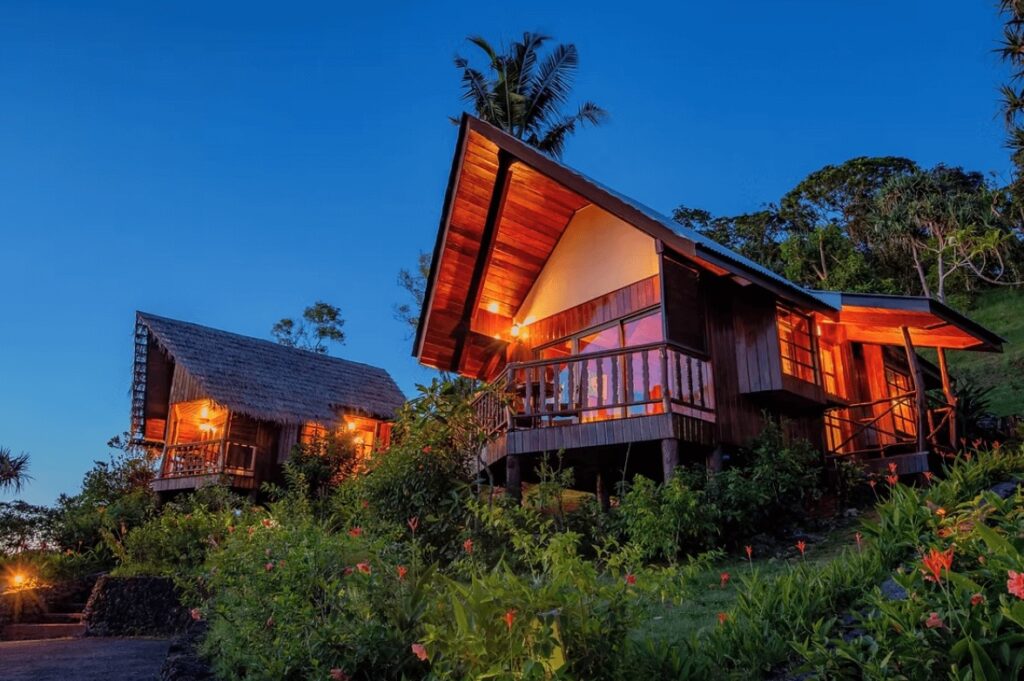
Non-diving activities in Palau
While scuba diving in Palau is an undisputed highlight of visiting this island nation, there are plenty of other activities to enjoy, both on and off the water. If you’re travelling with non-diving family/friends, trust us when we say they won’t get bored!
During our eight-night stay, we spent four days diving (three-tank dives each day), two days kayaking/snorkelling and one day with a rental car driving around the island. You can read more about that adventure here!
Honestly, we wish we had more days to explore. But I guess it’s always good to have a reason (or many) to come back!
Discover the World War II history of Peleliu Island
The Battle of Bloody Nose Ridge, which raged for nearly three months in 1944, was a clash between American and Japanese forces. It left an indelible mark on Peliliu Island.
Today, you can explore the battlegrounds and remnants of that fateful conflict on day trips from Koror. While the jungle has reclaimed much of the battlefield, the vestiges of war remain – rusting tanks, discarded ammunition and military artefacts lie strewn about.
Due to the threat still posed by unexploded ordnances, stay close to your guide and never wander off alone!
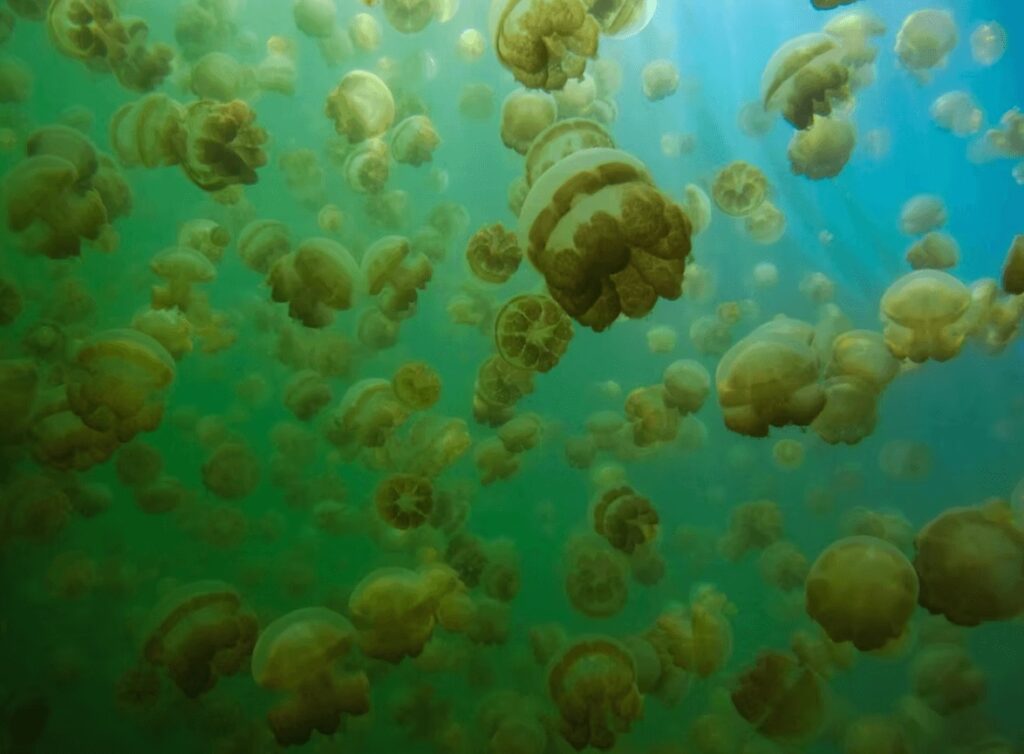
Snorkel in Jelly Fish Lake
This natural wonder offers a unique experience – being surrounded by thousands upon thousands of golden jellyfish gracefully drifting all around you. Their gently pulsing bells and billowing tentacles creating an almost otherworldly atmosphere.
What makes this encounter even more incredible is the fact that these jellyfish have lost their ability to sting, allowing you to safely swim amongst them. The water itself is crystal clear and serene, creating a sense of total calm and relaxation.
In Koror, you’ll find lots of operators offering day trips to Jelly Fish Lake – we went with Sam’s Tours but you can also ask at your hotel reception. Most are full-day adventures and include snorkelling around the islands and a visit to the Milky Way, famed for its milky, turquoise waters.

Explore the ancient Badrulchau Monoliths
On the northernmost point of the island of Babeldaob is this series of enigmatic stone monoliths.
According to local legend, these massive basalt columns were placed here long ago by a powerful deity. They were tasked with supporting the construction of a grand Bai – a traditional meeting house intended to house and unite all of the gods’ devoted followers.
The monoliths are arranged in two distinct rows. Some bear carvings that have sparked endless speculation and wonder among historians and archaeologists alike.
You can either reach the Badrulchau Monoliths as part of a guided tour or rent a car (like we did) and drive yourself. When we went, entrance was 5 USD – you pay whoever from the local community is stationed at the children’s playground that day. Bring cash!
A short drive up the road are the remains of a Japanese lighthouse, which is also worth visiting for its incredible views across the north of Babeldaob. The road up here, however, is not for the faint-hearted and best attempted in a 4WD. Entrance is 5 USD.

Photograph the traditional Bai house at the Belau National Museum
In Palau, each village once had its own Bai house that served as the central meeting place and community centre. At the start of the 20th century, over 100 of these impressive structures still stood.
These buildings were constructed with great skill and artistry. Their frames and walls were crafted from fine, durable hardwoods and their exteriors elaborately decorated with traditional designs.
Though many have been lost over the decades, the Bai house at the Belau National Museum stands as a powerful symbol of Palau’s cultural heritage. It’s also one of the easiest to visit on Babeldaob – you don’t need a permit or a guide to get here.
The museum itself is also worthy of a visit, providing loads of information about Palau’s natural history, culture and waves of colonisation. We spent around an hour and a half here, including some time in the fantastic gift shop!
The Belau National Museum is within walking distance of central Koror hotels and entrance is 15 USD (cards are accepted).

Marvel at the Ngardmau Waterfall
Rising to 30 metres in height and stretching 37 metres wide, this picturesque cascade plummets dramatically over the rocky cliffs of Babeldaob. As you venture downstream along the trail, you’ll discover a series of pools and miniature waterfalls.
The trail is dotted by remnants of Palau’s colonial past, including relics of the island’s former railway system from the Japanese occupation era. Just keep in mind that the trail can get slippery and muddy after heavy rain (which is common in Palau) and the humidity makes it a challenging hike.
Entrance to the Ngardmau Waterfall is 10 USD. You can visit as part of a guided tour from Koror or rent a car and drive here yourself.

Paddle between the Rock Islands
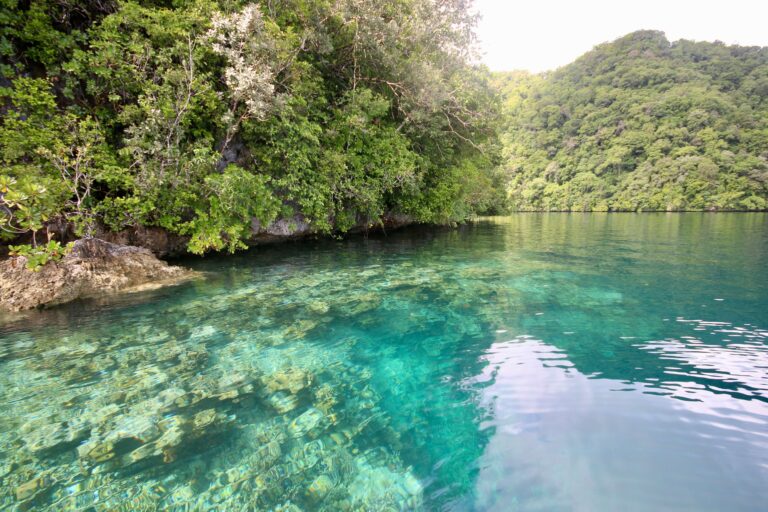
The UNESCO-listed Rock Islands of Palau are simply stunning and one of the best ways to experience them is by kayak.
We booked a full-day kayaking trip around Risong Bay with Paddling Palau and loved it so much that we booked to go again on their Nikko Bay trip. All of their team are local Palauans and their knowledge of the area’s natural history and culture is incredible.
With the vast majority of the islands devoid of permanent human habitation, the sense of solitude is palpable. As you glide silently between the coves and inlets, the only sounds are the gentle lapping of the waves and the calls of birds.
Paddling Palau’s kayaking trips are not just about paddling, however. They include snorkelling at several different spots within the bays, many of which are nurseries for fish.
On our Risong Bay trip, we snorkelled with golden and moon jellyfish (this is not at the main/busy Jelly Fish Lake) and got up really close to mandarin fish! When we went to Nikko Bay, a highlight was snorkelling at a site called “Rembrandt” – the coral colouration was out of this world!

Best time to dive in Palau
While diving in Palau is possible year-round, the high season, spanning from October to May, is considered the best time to visit. During these months, the water is typically calm, with visibility often exceeding 40 metres – an underwater photographer’s dream.
If you want to experience Palau’s spawning events, try and coincide your trip with the new or full moon. For reduced crowds (dive sites can get really busy here), avoid the Chinese New Year or Christmas/New Year holiday periods.
We visited in May and several dive guides/instructors said that this was a sweet spot for weather/crowds.
Water temperatures are generally between 27 and 30°C (81and 86°F), with most divers comfortable in a 3mm wetsuit. Some people were diving in shorties and others in skins.
During the rest of the year, you can expect an increase in rainfall and choppier seas. As a result, the visibility is not quite as good.
While diving is still possible during these months, with the majority of sites accessible, fewer visitors choose to vacation in Palau at this time. In short, you’ll experience uncrowded diving, but the quality of diving might not be quite as good.

Renting a car and driving in Palau
We weren’t intending to rent a car and drive in Palau, but so many people we spoke to said it was really easy and a great way to see the main island, Babeldaob. So on our last (non-diving) day, we did just that!
Aside from driving on the right-hand side of the road in a right-hand-drive vehicle (mind blown!), it was actually super relaxed and straightforward. The roads are in relatively good condition, people drive slowly and there was zero traffic once we got outside of Koror.
We spent a day doing a loop around Babeldaob, visiting some of the island’s cultural and natural attractions. After leaving Koror, we stopped at the Capitol of Palau to admire its monumental buildings and drove down to check out the surf break at Melekeok.
Then, we continued north to the Badrulchau Monoliths and the Todai lighthouse ruins, before heading back south to Koror via the Ngardmau Waterfall. There are a couple of other waterfalls to explore and some World War II ruins, but we ran out of time.
You can pick up a map of the island with the highlights marked at your hotel reception. We also bought a more detailed map (it was less than 2 USD) which had some written info about each of the attractions.
Keep in mind that most of the attractions have an entrance fee and they only take cash, so come prepared!
FAQs about diving in Palau
When is the diving season in Palau?
The best time to dive in Palau is between October and May, when the conditions are ideal. The water is pleasantly warm and exceptionally calm, with visibility often exceeding 40 metres. Meanwhile, the weather is reliably sunny and mild.
If possible, coincide your scuba diving in Palau trip with the new moon to witness the bump-headed parrotfish spawning. Alternatively, visit during the full moon to see large gatherings of bohar snapper.
During the rest of the year, you can expect an increase in rainfall and choppier conditions at the surface. However, there are fewer other divers in the water and more affordable accommodation deals. While the weather is more unpredictable during these months, the majority of Palau’s dive locations remain accessible.
What is there to see scuba diving in Palau?
Often referred to as the “Big Stuff” capital, this remote Pacific archipelago is teeming with life. It boasts an abundance of pelagic marine life that has been fiercely protected over the years.
Scuba diving in Palau means encountering sharks, manta rays and huge schools of other pelagic fish such as jacks, barracuda and snapper. Not to mention the distinctive bump-headed parrotfish.
But the wonders of Palau extend beyond just its charismatic megafauna. This island nation is also home to the captivating Jellyfish Lake, where millions of endemic, golden jellyfish undulate peacefully.
And for those seeking to explore Palau’s World War II history, the island’s lagoons and jungles are littered with the wreckage of long-abandoned planes, offering a window into the region’s past.
Another highlight of diving in Palau is the magnificent Chandelier Cave. Here, rays of light pierce through the water and illuminate the cavern’s stunning rock formations.
How much experience do you need to dive in Palau?
Provided you can handle a moderate amount of current and have learned the proper technique for using a reef hook, you’ll be well-equipped for diving in Palau.
That being said, our advice would be to aim for at least an Advanced Open Water diver certification. Ideally, combine this with Nitrox training.
This will ensure you have the necessary skills for scuba diving in Palau. Plus the confidence to make the most of your time in the water.
Should I stay at a dive resort or on a liveboard in Palau?
When planning a dive vacation in Palau, you can choose between liveaboard diving or resort-based diving. Each has its own advantages. It’s worth keeping in mind that most of the nation’s dive sites can easily be accessed from Koror, with a boat ride of between 40 and 60 minutes.
The liveaboard experience in Palau allows you to maximise your time spent underwater. Usually, up to five dives per day are offered. It’s a great option if you just want to dive, dive, dive and have everything included in a package.
The main drawback of liveaboard diving is that you generally have less room to move compared to a resort. Plus, there’s not much opportunity to participate in non-diving activities.
In contrast, shore-based diving at Palau’s resorts typically caps the daily dives at three, concluding by mid-afternoon. This leaves you with more time to experience the island’s terrestrial wonders.
There may be long-ish boat rides to get to the dive sites in the morning. Also, surface intervals will usually be spent on a small dive boat, rather than relaxing on a liveaboard sun lounger.
While a Palau liveaboard may appear pricier upfront, the overall cost can actually be comparable to a resort-based vacation. That’s once you factor in the limited budget accommodations that are available in Palau and the higher costs of dining out in this remote island paradise.
Are there whale sharks in Palau?
Situated in the heart of the western Pacific, Palau serves as a waystation for a procession of migratory marine life. Whale sharks, the largest fish on the planet, cruise through the waters. They’re drawn by the abundant plankton blooms that flourish in the nutrient-rich currents.
Manta rays also congregate in Palau’s sheltered lagoons and channels, where they come to filter-feed on clouds of zooplankton.
Generally speaking, January to April is the best time to see whale sharks and manta rays in Palau.
A variety of cetaceans – from humpback whales to acrobatic spinner dolphins – also make regular appearances. Most are taking advantage of Palau’s strategic location along their annual migration routes.
PLAN YOUR TRIP WITH OUR FAVOURITE RESOURCES:
Find hotels and resorts via Booking or Agoda
Book tours and experiences via Viator or GetYourGuide
Find a rental car via Discover Cars
Book flights via Kiwi or Booking
Search for buses and trains via 12Go or Omio
Get travel insurance via SafetyWing
Buy a digital eSIM with Airalo
By purchasing through our links, you’ll be supporting our website at no additional cost to you

We are a team of passionate divers and surfers with decades of combined experience in the water and travelling to all corners of the globe.
After years of chasing waves and descending into the deep blue, we’ve created this resource to highlight sustainable surf camps, eco-dive resorts and conservation-focused ocean trips to help inspire your next adventure.
Eco Ocean Escapes was born out of a love of the ocean, an obsession with travel and a concern about the impacts of our adventures on the environments we explore.