Eco-Friendly Surfer’s Packing List for a Sustainable Surf Trip
Wondering what to pack for a sustainable surf trip? Discover everything you need to bring (and what you can leave behind) in this essential surfers’ packing list.
When prepping for any surf vacation, it’s easy to just focus on boards – how many and how you’re going to get them there.
But there are so many other pieces of equipment, clothing and accessories that you need to consider, particularly if you’re heading to a remote surf camp or on a liveaboard trip.
In either of these situations, there might not be stores where you can pick up forgotten supplies. This is why nailing your packing list for a surf trip is soooo important.
As surfers, we believe we all have an obligation to help preserve our ocean playground, which is why sustainability should be at the forefront of our purchasing decisions.
What does this mean when planning your surf trip packing list?
Always consider the most eco-friendly options available, particularly if you need to go out and buy something brand new. Look for gear and accessories with non-toxic ingredients and think about ways you can reduce waste during your trip.
In this sustainable surfers’ packing list, we’re encouraging you to rethink what you need and minimise your environmental footprint.
Looking for easy ways to be an eco-conscious surfer? Check out our detailed article here.
Disclosure: This article contains affiliate links, meaning we earn a small commission when you make a purchase. Affiliate links cost you nothing and ensure our content stays free!
Weather conditions
When planning any surf trip, it’s important to research the weather and water conditions at your destination. It goes without saying that these will significantly affect what you pack.
If you’re going to be surfing in a cold climate, a wind-proof jacket and beanie will be lifesavers when you’re out on the boats. They’ll help to shield you from the biting winds as you get to and from the breaks.
But more importantly, you’ll need a thick wetsuit to help maintain your core temperature, allowing you to stay out in the surf for extended periods.
On the other hand, if you’re visiting a tropical surf destination, you’ll want to pack a much thinner wetsuit or simply a rash vest and board shorts. If you’re not sure, check the average water temperatures at your destination or ask the resort/camp directly.
When it comes to clothing, opt for lightweight, breathable pieces (ideally made from sustainable fibres) and always pack a few layers, no matter what the prevailing conditions. Chilly plane air-conditioning is reason enough to bring a sweater!

To rent or bring your own board
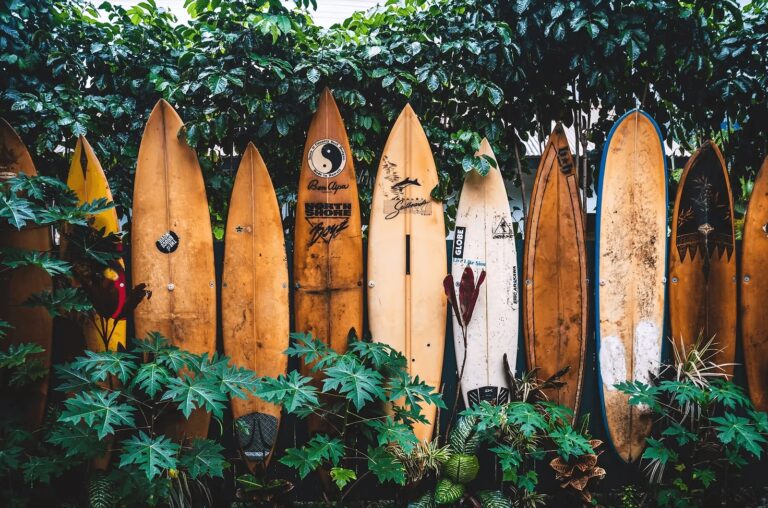
One of the biggest decisions you have to make in the lead-up to any surf trip is whether to bring your own surfboard or rent one at your destination.
If you’re riding your own board, you’ll know exactly what to expect and how it performs. This can be a major advantage, especially if you’re travelling to unfamiliar breaks.
And since you won’t have to waste time finding a rental, you can hit the waves as soon as you arrive…or early in the morning before the rental stores open.
Depending on airline excess baggage fees, bringing your own board might end up being cheaper than renting, especially for longer trips. For shorter stays, the daily rental rate could be less than the cost of flying abroad with your board.
Do your research to figure out what’s economically best for you!
Renting a board means you don’t have to lug around an awkward item or worry about it getting damaged/lost in transit. To avoid damage, we suggest wrapping your board in bubble wrap or padding your bag with clothing around the nose and tail.
Renting is usually preferable if you’re combining your surf trip with other land-based adventures. Trust us, we’ve learned from experience that finding taxis or using public transport with a surfboard in tow is not the easiest!
If the conditions at your destination aren’t well-suited to the boards you bring, you may find yourself struggling to perform. Renting gives you the flexibility to try out different shapes and sizes to find the right match for the waves the surf gods deliver.
The downside is the uncertainty of rental board quality and availability. Some surf destinations have a really limited selection and they’re often of average quality. We’ve discovered first hand that most aren’t investing in high-performance boards.
Ultimately, it’s a trade-off between the familiarity and potential cost-savings of your own equipment, versus the convenience and adaptability of renting. It’s a decision that depends on the specifics of your trip and personal preferences.
Land-based activities
While the primary focus of your trip may be surfing, chances are there will be land-based activities before or after…or on lay days when the waves aren’t delivering.
These are great opportunities to immerse yourself in the local culture and explore the surrounding environment, which can be just as rewarding as the surf itself.
Land-based activities could include everything from village visits to hiking trips and waterfall swims. Or you could get a different perspective on the ocean during scuba diving and snorkelling adventures.
To make the most of these opportunities, check the resort or surf camp offerings to understand the full scope of experiences available and pack any gear you might need.
This might include comfortable walking shoes or clothing that’s respectful to local communities. Sometimes a pair of shorts and a singlet just doesn’t cut it in traditional villages.
By planning ahead and leaving room in your luggage for these essential items, you can take advantage of everything the destination has to offer.
Eco-friendly surf packing list
Travel essentials
• Passport
• Travel insurance documents (we recommend Safety Wing)
• Reusable water bottle and/or water bottle filter
• Travel pillow for the plane
• Eye mask and ear plugs (in case you’re sharing a room)
• Laptop
• Phone
• Books/e-reader

Surf gear
If you are bringing your own boards, two to three is usually ideal. One of those should be your absolute favourite and the workhorse of your quiver.
It’s wise to have one or two backup boards suitable for different types of waves. This will give you the best chance of covering all your bases.
For instance, you may want a slightly larger board for those days when the swell is mellow and you need a little extra volume and flotation. Conversely, a smaller, more maneuverable board can be ideal for more technical conditions.
And with the unpredictability of surf travel, where boards can get damaged or lost, having that backup board can be a lifesaver.
• Surfboards
• Leashes
• Extra fins and fin key
Looking to be more sustainable in your surf consumption? Discover everything you need to know about sourcing second-hand surf gear and embracing the circular economy.
Clothing
When it comes to packing for a surf trip, it’s best to go easy on the clothing and travel light. Our advice is to focus on versatile, functional pieces that serve multiple purposes. This isn’t a fashion show after all.
Packing light is particularly important if you’re already travelling with boards and have maxed out your baggage weight limits.
In tropical destinations, you won’t need much more than a few lightweight layers to throw over your boardies or swimsuit.
If possible, choose sustainable fabrics that will break down naturally when they’re done being used. And try not to buy from stores that encourage fast fashion, which is disastrous for our planet.
Remember, a surf trip is not about trend-setting. Most surf camps, resorts and liveaboards have a really laid-back atmosphere and a casual “dress code”.
Chances are, everything you need will already be in your wardrobe or can be purchased affordably at thrift stores.
• Flip flops
• Broad-rimmed hat
• Sunglasses
• Singlets/t-shirts
• Shorts/pants
• Warm layers/beanies/gloves (cold environments)
• Sarong
• Underwear
• Good walking shoes and socks
• Bathers/swimwear
• Sleepwear
Health and wellbeing
Surf trips often take place in far-flung, isolated locations where accessing a pharmacy or medical care can be extremely difficult, if not impossible.
It’s crucial to plan ahead and ensure you have an ample supply of prescription medications, as well as any over-the-counter remedies you may require. This could include anything from motion sickness pills and antihistamines to pain relievers.
In tropical surf destinations, it’s also a good idea to bring your own first-aid kit. This should include antiseptic creams to deal with cleaning and disinfecting reef cuts.
Pawpaw cream can also be a godsend for soothing painful abrasions while tweezers will help you extract any pesky splinters from urchin spines. Trust us, we’ve been there!
After long sessions in the water, tiger balm or a similar salve will provide much-needed relief from muscle soreness. It’s not essential, but highly recommended.
• Prescription medications
• Paracetamol/ibuprofen
• High-SPF reef-safe sunscreen + zinc
• Sea-sickness medication (if you’re on a liveaboard)
• Eco-friendly insect repellent
• Chemical-free toiletries (bar shampoos/conditioners are great eco-friendly options)
• Hand sanitiser
• Personal care items for women

PLAN YOUR TRIP WITH OUR FAVOURITE RESOURCES:
Find hotels and resorts via Booking or Agoda
Book tours and experiences via Viator or GetYourGuide
Find a rental car via Discover Cars
Book flights via Kiwi or Booking
Search for buses and trains via 12Go or Omio
Get travel insurance via SafetyWing
Buy a digital eSIM with Airalo
By purchasing through our links, you’ll be supporting our website at no additional cost to you
About the authors
We are a team of passionate divers and surfers with decades of combined experience in the water and travelling to all corners of the globe. After years of chasing waves and descending into the deep blue, we’ve created this resource to highlight sustainably run surf camps, eco-friendly dive resorts and conservation-focused ocean trips to help inspire your next adventure.
Eco Ocean Escapes was born out of a love of the ocean, an obsession with travel and a concern about the impacts of our adventures on the environments we explore. Despite the benefits that surf and dive tourism can bring to local communities, we recognised that ocean-based adventures are not always managed in a sustainable manner.
Through our articles, we hope to inspire those seeking a responsible surf or dive trip that is all about supporting local communities, preserving our coastal environments and the incredible marine species that inhabit our oceans.
-
The Blue Revolution: How Ocean Conservation Is Changing Travel
If you’re anything like us, the ocean is what fuels your travel adventures. Over the last 20+ years, we’ve flown across the globe to dive with manta rays, kayak above coral reefs and surf legendary waves. But there is an uncomfortable contradiction at the heart of ocean tourism: the healthier the marine environment, the more…
-
Climate Change in the Ocean: A Guide for Surfers + Divers
When we think about climate change, our attention naturally turns to what we can see on land or are experiencing first hand: rising temperatures, melting glaciers, wildfires and more intense weather events. Many of these are well-reported on the nightly news and it’s devastating to see intense wildfires ripping across landscapes and floods wreaking havoc…
-
Resort vs Liveaboard vs Homestay Diving in Raja Ampat: Choosing the Right Experience
Raja Ampat is one of my favourite diving destinations in Indonesia. In fact, that’s probably an understatement. Raja is one of my favourite places to dive anywhere in the world. The underwater experiences I’ve had here are nothing short of extraordinary…and that’s not taking into account the incredible above-water scenery. It really does feel like…
-
How Sunscreen Affects Coral Reefs + Marine Life
If you’re anything like us, applying sunscreen is second nature before heading out to surf or spending a day on a dive boat. In fact, our skin type means we need to apply sunscreen before we step outdoors…full stop! Since we were little, it’s been drummed into us that sunscreen protects our skin from harmful…
-
The Essential Scuba Diving Guide to Raja Ampat, Indonesia
Few places we’ve dived have captured our imagination quite like Raja Ampat. Our first visit was back in the early 2000s, staying at a homestay on a blissfully gorgeous beach, and our second in 2023 at the eco-friendly Papua Explorers Resort. Both are experiences that will stay with us forever and affirmed what so many…
-
Successful Marine Protected Areas You Can Visit Around the World
After almost two decades of scuba diving around the globe, we’ve come to the conclusion that marine protected areas (MPAs) are one of the most powerful tools we have for conserving ocean ecosystems. Essentially, they are like “national parks of the seas” – established to limit activities such as overfishing, habitat destruction and unsustainable development….



We are a team of passionate divers and surfers with decades of combined experience in the water and travelling to all corners of the globe.
After years of chasing waves and descending into the deep blue, we’ve created this resource to highlight sustainable surf camps, eco-dive resorts and conservation-focused ocean trips to help inspire your next adventure.
Eco Ocean Escapes was born out of a love of the ocean, an obsession with travel and a concern about the impacts of our adventures on the environments we explore.