Are Wave Pools Sustainable? The Surf Park Environmental Debate
Nothing compares to surfing in the ocean. Full stop. For us, being at the whim of Mother Nature is a big part of surfing’s allure, and all things being equal, we’d pick the ocean over a wave pool every time.
But with coastal communities under increasing pressure and surf breaks being flooded with people, are wave pools an opportunity to release that strain?
Wave pools guarantee surf sessions without the unpredictability. They’re about perfectly shaped waves and consistent conditions (that the ocean doesn’t always deliver).
For city-based or inland surfers, they offer access and reliability, without long trips to the coast that may end in disappointment when the surf gods don’t answer your prayers.
But as wave pools proliferate, from desert resorts to suburban surf parks, questions around their sustainability are being asked.
Are artificial wave pools bad for the environment? Do wave pools reduce pressure on surf breaks? Or are wave pools simply relocating surfing’s environmental footprint?
In this article, we’ll explore the wave pools vs ocean surfing sustainability debate and address the environmental impact of surf parks. We’ll look at the energy and water use of wave pools, and how site selection and design impact their eco-credentials.
The Case for Wave Pools
Let’s start with some positives. Supporters argue that wave pools could ease pressure on natural surf breaks already strained by over-tourism, coastal development and climate change.
In theory, wave pools can reduce crowding at sensitive coastal breaks and create access to surfing without long-haul travel (whether that’s by road or air). This could (potentially) lead to a reduction in the average emissions of a surf session. It all depends on the location.
Additionally, wave pools offer a controlled environment where beginners can learn and train. If you’re someone who has been hit by a rogue board belonging to a beginner (or you’re a beginner worried about hitting someone with your rogue board), then that is a good thing!
The predictable nature of surf park waves and the limited number of people in the water create a user-friendly environment for novices to hone their skills. There’s no worrying about rips or a huge set coming, and you don’t have to compete for your turn in a heated lineup.
For landlocked surfers, wave pools eliminate the need for frequent flights, and they can shift surf tourism inland, away from fragile shorelines. The building of sustainable surf parks and wave pools means you don’t have to road trip hours down the coast every weekend to get your wave fix.
For coastal towns already struggling with overtourism, they could act as pressure valves. We don’t think wave pools would ever halt the ocean pilgrimage that surfers make on weekends and holidays (or whenever a swell is forecast). But they could help to slow the rapidly increasing numbers of recent years.
The Case(s) Against Wave Pools
Energy Use
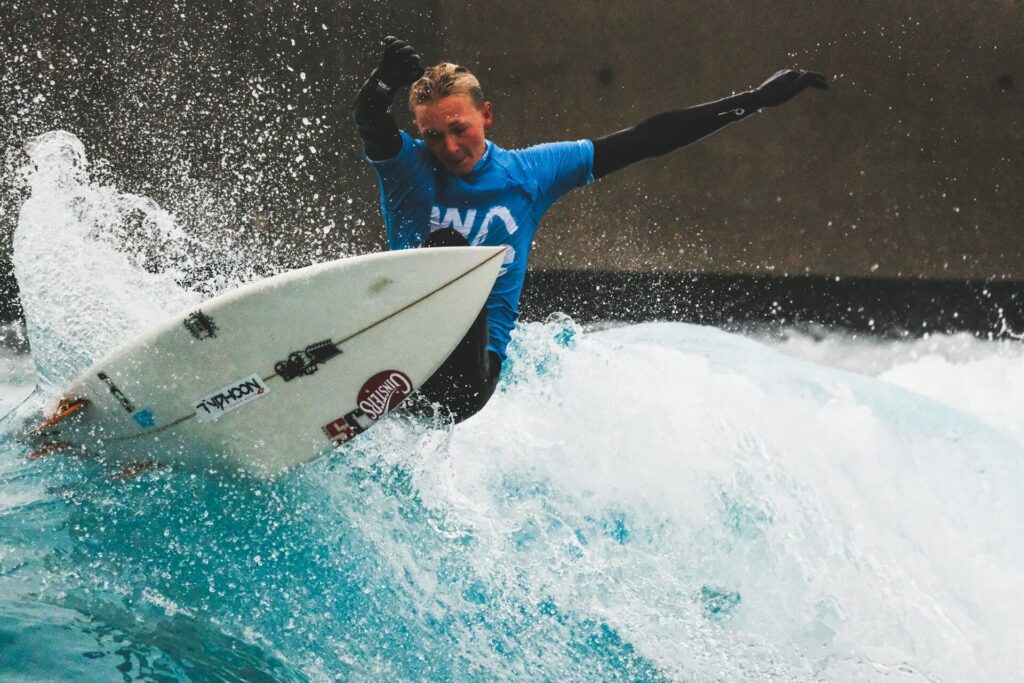
And now to the cons. The largest sustainability concern around wave pools is energy usage.
Generating artificial waves requires power…often a lot of it…and sometimes drawn from fossil-fuel-heavy grids.
The environmental impact of a wave pool’s energy use depends heavily on the wave technology used, the size and frequency of the waves, and where local energy is being sourced. Surf park energy use varies from place to place.
Some newer systems claim increased efficiency, producing fewer waves with less energy. Others rely on renewable power, solar integration or energy offset programs to minimise their environmental footprint. The most sustainable surf parks and wave pools combine all of the above.
When wave pools draw from fossil-fuel-heavy grids, the carbon footprint can well and truly exceed that of a regular surf trip to the coast. If that’s the case, they’re not a sustainable option by any stretch of the imagination.
Unless a wave pool is transparent in where its energy is coming from, it’s difficult to determine how “sustainable” it is. But getting access to that info isn’t always easy.
Water Consumption and Scarcity
Water use is another issue. Wave pools require millions of litres of water, and when they are being built in regions already facing water scarcity, any “sustainable” claims are questionable.
While many systems recycle water and use liners to reduce loss, evaporation (especially in hot climates) can’t be avoided.
It’s estimated that the Surf Ranch in California loses tens of thousands of gallons of water a week…and not just from evaporation. Strong winds, splash out and water loss through mechanical filtration systems account for around half of this figure.
Using potable water for recreational waves raises ethical questions, particularly in drought-prone areas. If potable water is being diverted to wave pools (because they’ll pay big bucks for it), instead of human populations, then it’s not a socially responsible way to surf.
That’s not to say all wave pools are being water hogs. Some projects are experimenting with non-potable or recycled water and working hard to improve evaporation controls.
At the end of the day, water sustainability in wave pool design depends largely on geography. In short, they should only be built in climate-appropriate locations.
And as wave pool technology advances, we have our fingers crossed that the technology around water loss will improve too.
Land Use and Local Impact
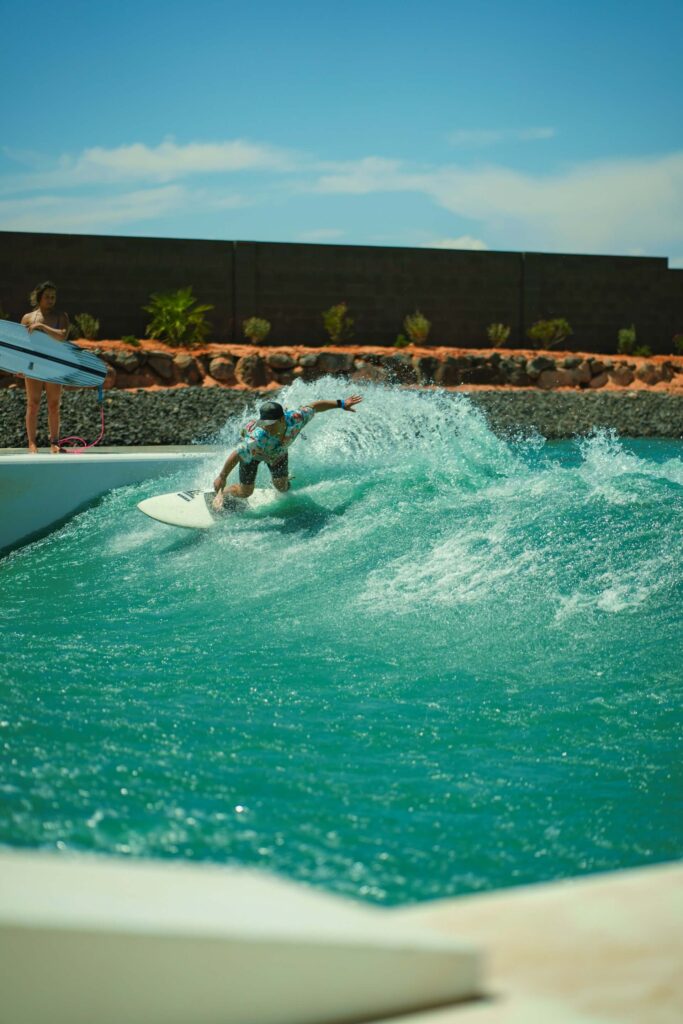
Wave pools don’t exist in isolation. They come with a whole host of other infrastructure – parking lots, cafes, retail stores and (sometimes) accommodations.
Built responsibly, they can revitalise post-industrial land and create local jobs, all while providing accessible waves for urban-based surfers.
But built poorly, wave pools can contribute to urban sprawl, car dependency and habitat loss for local wildlife. It all depends on site selection and the regional impacts of that decision.
As with any large-scale development, the question is not just what is built, but where, for whom and at what cost.
The Illusion of “Eco” Surfing
Wave pools are sometimes marketed as “eco-friendly alternatives” to ocean surfing. But we think this framing can be misleading…and not just for the reasons mentioned above.
Surfing in the ocean, at its simplest, requires no infrastructure beyond the surfer themselves. The environmental costs stem from air/road travel, gear production/consumption and demand for coastal development. Not from the waves themselves.
But with wave pools, it is the waves that are the issue, as they require constant energy input to function. And you still have to fact in travel, gear production/consumption and the environmental costs of surf park infrastructure.
Just because you’re not emitting as much carbon to get to a wave pool doesn’t mean your surf session has a smaller footprint.
The environmental impact of wave pools is often a “behind the scenes” issue. Unfortunately, information isn’t always made readily available to the public.
Currently, the onus lies with eco-conscious surfers to ask the tougher questions regarding the sustainability of surf parks and wave pools.
The Social Question
Sustainability isn’t only environmental. It’s also social.
Wave pools are often expensive, pay-per-session experiences. It’s been estimated that it costs roughly 172 USD per wave to surf at Surf Abu Dhabi in the UAE. It better be a good ride!
Not all wave pools are that expensive, however. URBNSURF in Melbourne, Australia, offers sessions starting from around 70 USD per hour. That equates to roughly 7 USD per wave. Still not cheap!
This raises questions about equity, access and who benefits from surf innovation.
If wave pools remain financially exclusive, their contribution to a more sustainable surf culture is limited.
Can Wave Pools Be Part of a Sustainable Future for Surfing?
Wave pools are not inherently sustainable, nor inherently bad for the environment. Their impact depends on how they are designed, powered and integrated into broader systems of travel, recreation and consumption.
From our perspective, wave pools could play a positive role in making surfing more accessible and reducing pressure on coastlines.
But only if they are built in appropriate climates and on land that couldn’t be better purposed for humans or wildlife. If the site is in demand for housing or habitat, a wave pool isn’t a priority.
Ideally, the location should be selected with the aim of reducing travel times and overall emissions for surfers in the region.
Rather than drawing on fossil-fuel resources, wave pools should be powered by verified renewable energy sources and operate transparently, with measurable environmental reporting.
Recycled or non-potable water should be used, particularly in regions that are impacted by water scarcity. And improving water loss needs to be a priority as surf park technology develops.
Personally, we can’t see a world in which wave pools will ever replace the feeling of surfing in the ocean. But as natural surf breaks around the globe grapple with issues around access, climate pressure and overcrowding, artificial waves can have a role to play.
As surfers striving to reduce our environmental impact, we’re less interested in the ability of wave pools to churn out perfect, reliable waves and more interested in their willingness to be a genuinely sustainable alternative. And that means asking a lot of hard questions.
PLAN YOUR TRIP WITH OUR FAVOURITE RESOURCES:
Find hotels and resorts via Booking or Agoda
Book tours and experiences via Viator or GetYourGuide
Find a rental car via Discover Cars
Book flights via Kiwi or Booking
Search for buses and trains via 12Go or Omio
Get travel insurance via SafetyWing
Buy a digital eSIM with Airalo
By purchasing through our links, you’ll be supporting our website at no additional cost to you
-
The Blue Revolution: How Ocean Conservation Is Changing Travel
If you’re anything like us, the ocean is what fuels your travel adventures. Over the last 20+ years, we’ve flown across the globe to dive with manta rays, kayak above coral reefs and surf legendary waves. But there is an uncomfortable contradiction at the heart of ocean tourism: the healthier the marine environment, the more…
-
Climate Change in the Ocean: A Guide for Surfers + Divers
When we think about climate change, our attention naturally turns to what we can see on land or are experiencing first hand: rising temperatures, melting glaciers, wildfires and more intense weather events. Many of these are well-reported on the nightly news and it’s devastating to see intense wildfires ripping across landscapes and floods wreaking havoc…
-
Resort vs Liveaboard vs Homestay Diving in Raja Ampat: Choosing the Right Experience
Raja Ampat is one of my favourite diving destinations in Indonesia. In fact, that’s probably an understatement. Raja is one of my favourite places to dive anywhere in the world. The underwater experiences I’ve had here are nothing short of extraordinary…and that’s not taking into account the incredible above-water scenery. It really does feel like…
-
How Sunscreen Affects Coral Reefs + Marine Life
If you’re anything like us, applying sunscreen is second nature before heading out to surf or spending a day on a dive boat. In fact, our skin type means we need to apply sunscreen before we step outdoors…full stop! Since we were little, it’s been drummed into us that sunscreen protects our skin from harmful…
-
The Essential Scuba Diving Guide to Raja Ampat, Indonesia
Few places we’ve dived have captured our imagination quite like Raja Ampat. Our first visit was back in the early 2000s, staying at a homestay on a blissfully gorgeous beach, and our second in 2023 at the eco-friendly Papua Explorers Resort. Both are experiences that will stay with us forever and affirmed what so many…
-
Successful Marine Protected Areas You Can Visit Around the World
After almost two decades of scuba diving around the globe, we’ve come to the conclusion that marine protected areas (MPAs) are one of the most powerful tools we have for conserving ocean ecosystems. Essentially, they are like “national parks of the seas” – established to limit activities such as overfishing, habitat destruction and unsustainable development….

We are a team of passionate divers and surfers with decades of combined experience in the water and travelling to all corners of the globe.
After years of chasing waves and descending into the deep blue, we’ve created this resource to highlight sustainable surf camps, eco-dive resorts and conservation-focused ocean trips to help inspire your next adventure.
Eco Ocean Escapes was born out of a love of the ocean, an obsession with travel and a concern about the impacts of our adventures on the environments we explore.